
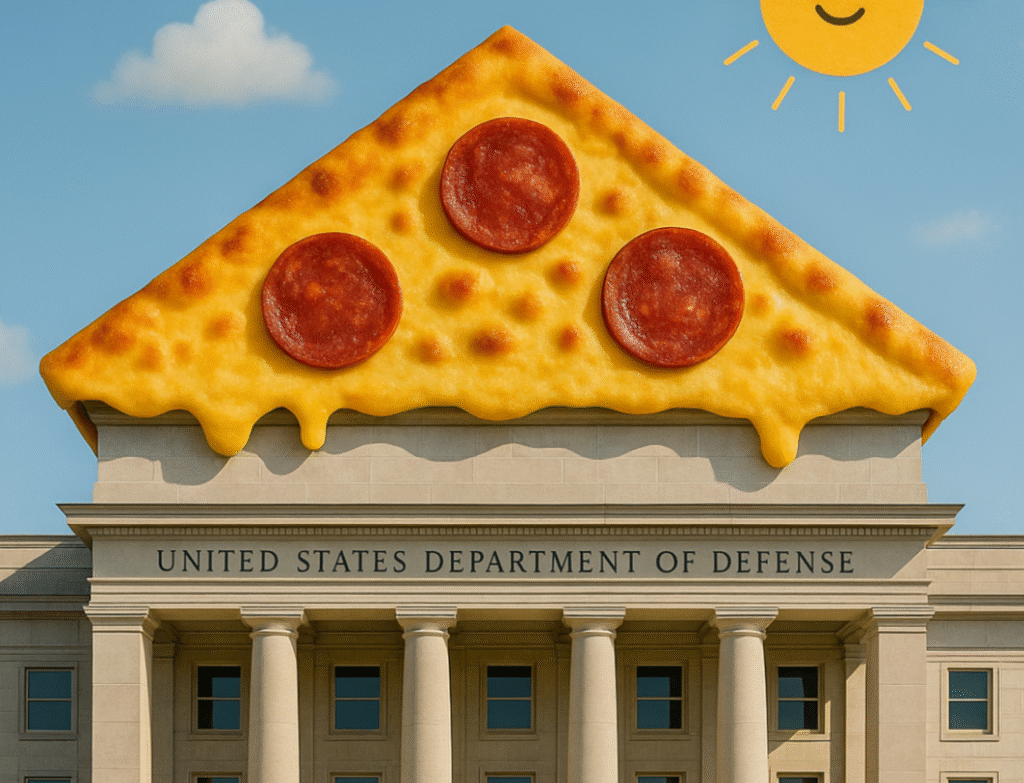
Have you ever imagined that the fate of nations might be hinted at not in classified cables or encrypted channels—but in the glowing heat lamps of Pentagon-area pizza shops? It sounds absurd, even comical, yet the legend of the Pentagon Pizza Index refuses to die. And perhaps, buried beneath the cheese and sauce, lies a strangely compelling story.
I. A Theory Born From Late-Night Cravings (Or Something More?)
They say the world’s biggest decisions often happen behind closed doors. But what no one talks about is what happens before those decisions: the long nights, the tense discussions, the exhausted analysts and generals who simply need fuel.
And so emerged an unusual hypothesis—half folklore, half OSINT fantasy—that late-night pizza orders around the Pentagon spike right before something big goes down.
It’s not official. It’s not proven. But it’s too delicious a theory to ignore.
II. Why Pizza? Why the Pentagon?
Imagine being part of a high-stakes meeting that suddenly stretches into the early hours. You can’t leave. You can’t take a break. And you absolutely can’t cook.
Enter: Pizza.
Hot, cheap, fast, and available in bulk—pizza has long been the unofficial currency of crisis rooms.
Add to that the Pentagon’s prime location in Arlington, surrounded by more pizza chains than security checkpoints, and you get the perfect storm.
But here’s where it gets interesting.
Public data—Google Maps traffic, delivery app patterns, even social media chatter—begins to reveal strange spikes. And a corner of the internet took notice.
On X/Twitter, an account named Pentagon Pizza Report tracks these numbers like weather forecasts. Reddit has entire threads dedicated to late-night delivery vans circling the Pentagon. OSINT nerds zoom in on every pizza shop ping in Northern Virginia.
It’s part serious analysis, part internet theatre. But sometimes… the patterns line up a little too well.
III. The Strange, Saucy Timeline of Pizza and Power
No one wants to admit it, but history has receipts—pizza receipts.
Below are some of the most eyebrow-raising correlations that keep the legend alive:
- Aug 1, 1990 — Pre-Gulf War: A surge of Pentagon-area pizza orders reportedly preceded Saddam Hussein’s invasion of Kuwait.
- Jan 1991 — Operation Desert Storm buildup: Orders spiked as coalition forces prepared their assault.
- Dec 1998 — Operation Desert Fox: Three pizza chains reported unusual late-night surges during the Iraq bombing campaign.
- Oct 1998 — Clinton Impeachment Hearings: White House lawyers and strategists apparently operated on a pizza-only diet.
- May 2011 — Bin Laden Raid: The now-famous blackout helicopter mission allegedly followed a spike at Joint Base Andrews.
- Jan 2020 — Soleimani Strike: Northern Virginia pizza shops stayed unusually busy.
- June 12, 2025 — Israel–Iran Escalation: A 3.8× spike in orders just hours before airstrikes hit Tehran.
Coincidence? Maybe. But coincidences accumulate, and legends are born.
IV. The Critics Roll Their Eyes… and Yet
Official Pentagon spokespeople laugh this off.
Absolutely not, they say.
No secret war-room relies on Domino’s.
But critics point out four big holes:
- False alarms happen. A busy Friday night doesn’t mean bombs are about to fall.
- Data is often vague. Delivery apps don’t give timestamps with the precision of a missile strike.
- Correlation ≠ causation. But people love patterns.
- Confirmation bias is real. Once you believe in the Index, every pepperoni pie feels like a warning.
Still, the theory refuses to die because—if you squint—sometimes it feels just plausible enough.
V. From Cold War Shadows to Internet Lore
Rumor has it that during the Cold War, Soviet watchers looked at everything—from dry cleaning patterns to restaurant reservations—to predict U.S. moves.
So the idea that modern OSINT warriors track pizza isn’t that far-fetched.
They even gave the practice a name: Pizzint—Pizza Intelligence.
Journalists joke about it. Analysts reference it with a smirk. But behind the humor is a reflection of the world we now live in.
A world where even a pizza order leaves a digital footprint.
A world where nothing is too small to matter.
VI. The Final Slice
Does the Pentagon Pizza Index actually predict war? Probably not.
But does it reflect a deeper truth—that in an age of total digital visibility, even the most mundane human actions can become signals? Absolutely.
Maybe the Index is less about pizza and more about the era we inhabit—where stories, data, behavior, algorithms, and human hunger blend into one strange, fascinating soup.
In the end, whether or not pizza orders can forecast military decisions, the legend endures because it makes intelligence feel almost… human.
And who knows? The next time the Pentagon lights burn a little too late and a delivery driver zips down Route 27, the internet will be watching.
After all, in geopolitics—and pizza—you never know what the next slice will reveal.
Appendix: Key Monitoring Platforms
- Twitter: @PentagonPizzaReport
- Reddit: r/OSINT and r/Geopolitics
- Google Maps
Recommended Citation: Pentagon Pizza Index: A Behavioral Indicator of Impending Military Action.
Pingback: URI 2.O:Indias Another Surgical strike – this time (in Myanmar) - Anything