New Delhi never really sleeps, but on the night of November 10, 2025, it woke up in a way no city should.
One explosion—just one—outside the Red Fort was enough to shake not just Old Delhi, not just the capital, but the entire nation’s sense of security. And as smoke curled around one of India’s most iconic monuments, it became clear that this wasn’t merely an incident.
It was a moment.
A rupture.
A reminder of how fragile peace can feel in turbulent times.
The Moment the Calm Shattered
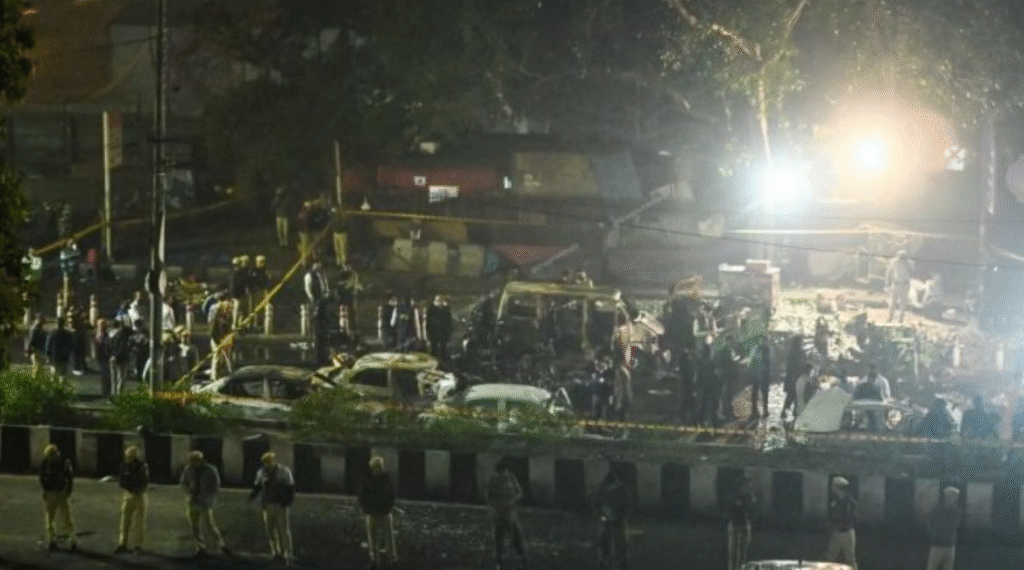
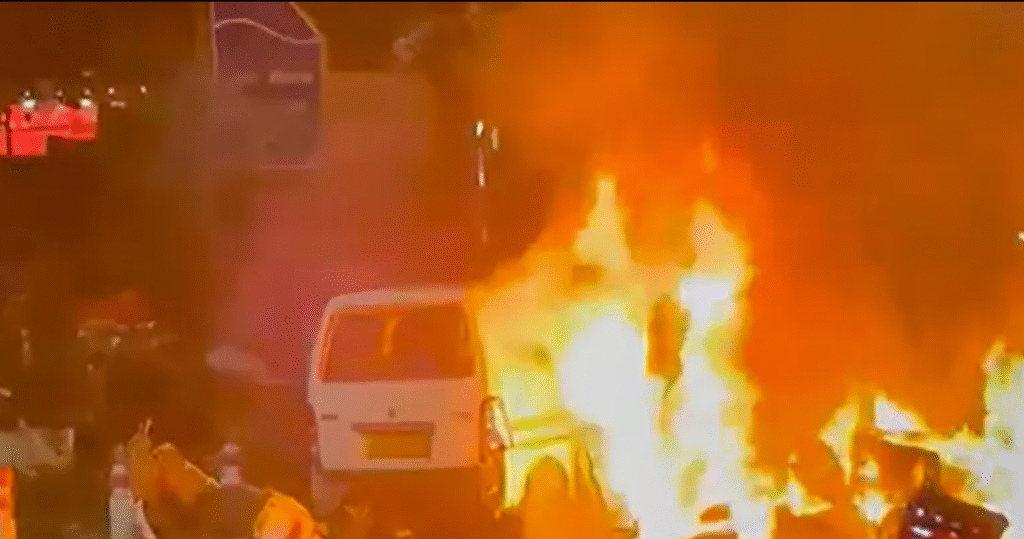
It was a regular Delhi evening—traffic chaos, honking cars, street vendors shouting over each other—until 6:50 PM, when a Hyundai i20 waiting at a red light simply… exploded.
No warning. No gunmen. Just a sudden eruption that sent flames higher than the metro pillars and a shockwave straight through the heart of Old Delhi.
People who’ve lived their whole lives near the Red Fort say they’ve never heard anything like it.
Shopkeeper Anwar Khan, who has seen monsoon floods, political protests, and chaotic winters, summed it up in one sentence:
“Flames rose higher than the streetlights. It felt like a thunderclap from nowhere.”
Within minutes, the ancient lanes around Chandni Chowk were painted in reds and blues—sirens, firetrucks, ambulances, panic, confusion. It felt like history folding into itself.
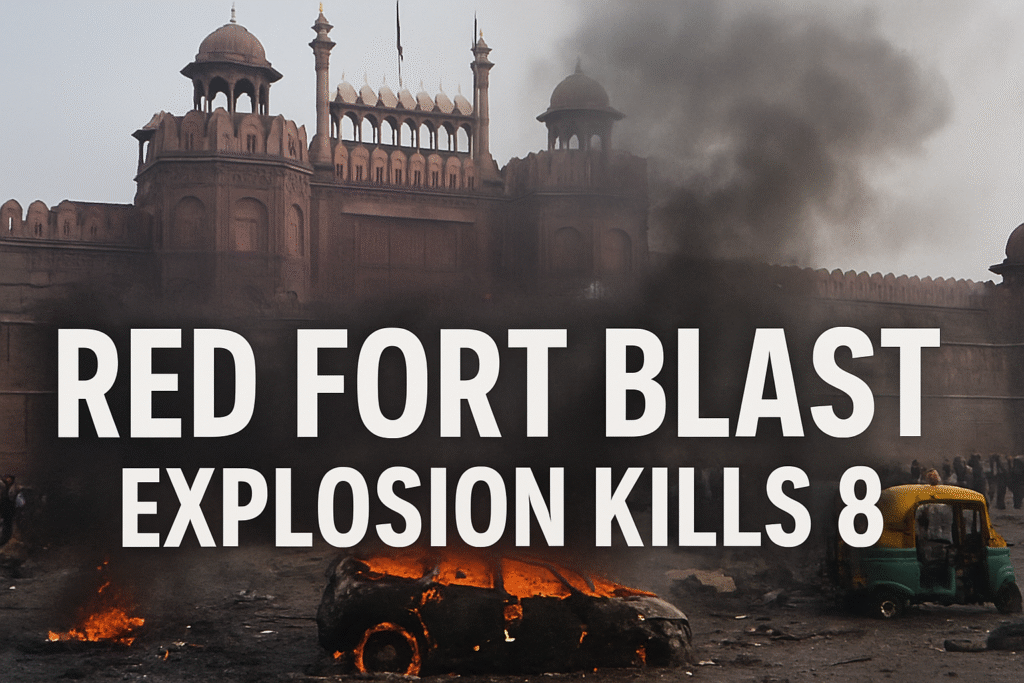
The Red Fort—usually glowing under yellow floodlights—looked wounded.
Eight people died.
More than two dozen were pulled from the wreckage.
Some will never walk the same roads again without feeling that invisible tremor of fear.
The Investigation: More Questions Than Answers
Delhi Police and the NIA responded fast—because when something blows up this close to the Red Fort, it’s more than a crime scene.
It’s a national crisis.
But the early investigation only deepened the mystery.
- No traditional shrapnel.
- No obvious military-grade explosive.
- A car that changed hands too many times.
- A Faridabad explosives seizure just 24 hours earlier… maybe connected, maybe not.
Was it terror? Was it sabotage? Was it a freak mechanical disaster? Or was it something far more insidious—a symbolic strike meant to create panic, not casualties?
Right now, theories outnumber facts.
And in modern India, that’s always dangerous.
A City on Edge, A Nation Holding Its Breath
The Red Fort isn’t just a monument—it’s where India speaks to the world. It’s where prime ministers stand every Independence Day. It’s where tourists gather, where schoolchildren stare in awe, where history lives.
So when something explodes outside it, even accidentally, the psychological impact is enormous.
Overnight:
- Airports went into high alert.
- Metro stations upgraded checks.
- Drones circled over Connaught Place.
- Police presence multiplied in every major Indian city.
Delhi, already tired from political noise and never-ending security drills, slipped into an uneasy quiet.
Politics Reacts—As Politics Always Does
Prime Minister Modi called it
“an attack on peace and humanity.”
Home Minister Amit Shah summoned emergency meetings.
Opposition leaders united—in words, at least—condemning the blast, urging calm.
And social media?
A battlefield.
Hundreds of armchair analysts.
Dozens of conspiracy theories.
A few responsible voices drowned in a sea of noise.
Everyone had something to say; very few had anything meaningful.
The Human Pulse: Where Real Pain Lives
In every tragedy, one truth stands out:
Statistics don’t bleed. People do.
A food delivery rider who didn’t make it home.
A father waiting to pick up his daughter from the metro.
Tourists who wanted photos, not funerals.
Their stories matter more than any political press conference.
Their silence screams louder than any trending hashtag.
The Blast in a Bigger World
Nothing happens in isolation anymore.
Globally, the world is simmering—wars, cyberattacks, economic turbulence, political polarization. India is no stranger to this global anxiety.
Every nation today is walking on a tightrope stretched between security and uncertainty.
The Red Fort blast—regardless of what the forensic report eventually concludes—fits into a larger pattern:
symbolic strikes meant to fracture confidence, not territory.
The age of “micro-terrorism.”
Small acts, big psychological impact.
International Eyes Turn to Delhi
World capitals reacted immediately.
The US, UK, France, Japan—everyone condemned the blast.
The UN offered support.
Pakistan—predictably—distanced itself from speculation.
The world wasn’t just watching.
It was worried.
Because when a fireball lights up the Red Fort, it sends ripples far beyond Delhi’s old walls.
Where Does India Go From Here?
Forensic teams will identify chemicals.
Intelligence agencies will trace calls.
Police will follow the money.
But there’s a larger question India must confront:
Are we prepared for an era where chaos doesn’t need a mastermind—just an opportunity?
The blast exposed gaps—not necessarily in security, but in the fragile trust citizens place in their surroundings.
Fear travels fast.
Recovery travels slow.
Closing Thoughts: Fire, Fragility, and the Spirit of Delhi
Delhi has burned before.
Delhi has grieved before.
Delhi has rebuilt before.
November 10, 2025 will join that long list of days when the city’s heartbeat stuttered—but did not stop.
For some, the Red Fort will forever carry the smoke of this night.
For others, it will be a reminder of resilience.
For all of us, it is a call to stay alert, stay humane, and stay united.
India’s capital may tremble—but it never bows.
And when dawn rises over the Red Fort tomorrow, it will rise over a city that survived one more test of its unbreakable spirit. united in the smoke.
Sources: NDTV, Reuters, AP, India Today, Ministry of Home Affairs Briefing, and eyewitness accounts.