

Introduction
Assam—rich in culture, ethnicity, and complex border histories—has long grappled with migration-driven demographic change. In recent years, under Chief Minister Himanta Biswa Sarma, the state has intensified administrative, legal, and cultural measures aimed at protecting Assamese identity, land resources, and demographic stability. While some observers refer to this evolving approach as a targeted campaign, it is more accurate and responsible to understand it as a broad policy framework driven by concerns over undocumented immigration, cultural preservation, and land management.
This rewritten analysis provides a neutral, policy-oriented narrative, avoiding community labels in a pejorative context and focusing strictly on historical developments, legal instruments, and administrative actions.
Historical Context: The Roots of Assam’s Identity Debate
Colonial-Era Migration and Early Settlement Patterns
Migration from present-day Bangladesh into Assam began during British rule, when colonial administrators encouraged the movement of peasants to cultivate fertile lands. The Partition of 1947 and the 1971 Bangladesh Liberation War further accelerated cross-border movement—some documented, some not.
These demographic shifts generated long-standing anxieties among indigenous Assamese groups regarding land, political representation, and cultural preservation.
The Assam Agitation (1979–1985)
The All Assam Students’ Union (AASU) launched a mass movement demanding the detection and deportation of undocumented immigrants. The agitation marked one of the most tumultuous phases in Assam’s modern history, leading to:
- Statewide protests and clashes
- A heightened focus on demographic integrity
- The Assam Accord (1985), which set March 25, 1971 as the cut-off date for identifying undocumented migrants
Rise of Regional Militancy
Parallel to the agitation, the United Liberation Front of Asom (ULFA) emerged, promoting Assamese sovereignty and blaming demographic changes on inadequate border and migration policies. While the group’s insurgency has since lost momentum, its early manifestos reflect the sentiment that demographic concerns were tied to deeper political alienation.
Recent Administrative Phase: The State’s Preservation‑Oriented Strategy
Since 2016—and more prominently after 2021—the Assam government has adopted a series of legal, cultural, and land-related reforms aimed at reinforcing Assamese identity and preventing undocumented migration. While informal terms circulate in public discourse, this analysis focuses on verifiable administrative actions and policy objectives.
Core Policy Objectives
- Cultural Preservation – Strengthening Assamese language and heritage in educational and public institutions.
- Land Protection – Preventing encroachment on government, forest, and tribal lands.
- Border and Migration Governance – Enhancing documentation, identification, and verification processes.
- Administrative Enforcement – Addressing activities deemed unlawful, irrespective of community.
These measures are framed by the government as protections for indigenous rights and resource security, though critics argue that the implementation has disproportionately affected marginalized populations.
Citizenship Amendment Act (CAA): A Complex Interplay in Assam
What the CAA Does
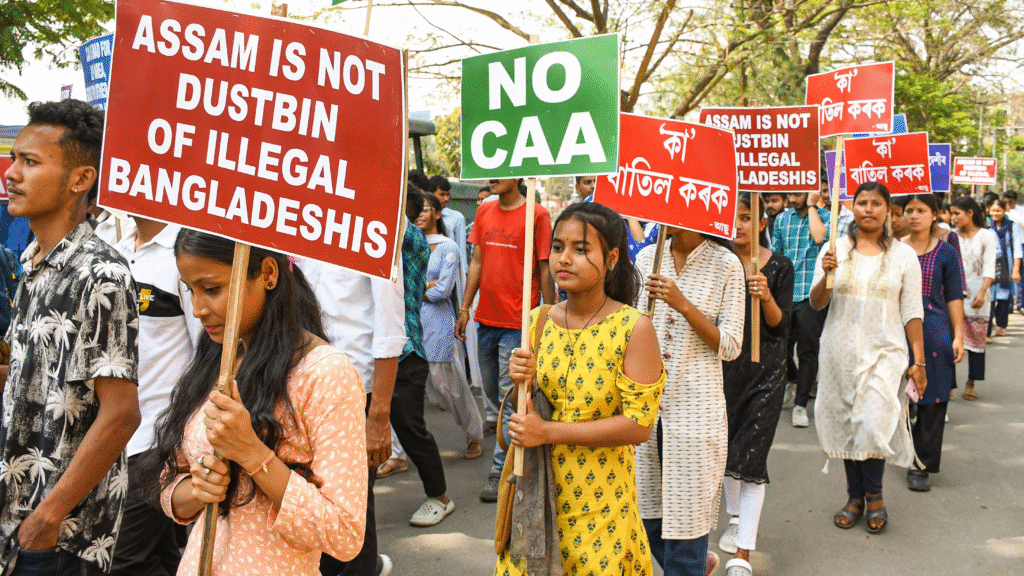
The Citizenship Amendment Act (2019) provides fast-track citizenship to non-Muslim migrants from Bangladesh, Pakistan, and Afghanistan who entered India before December 31, 2014.
Why Assam’s Response Was Unique
While national protests largely focused on the Act’s religious criteria, Assam’s opposition stemmed from linguistic and ethnic concerns:
- Critics feared that CAA could legitimize additional migration—particularly from Bangladesh—regardless of religion.
- This was seen as contradictory to the Assam Accord’s principles.
2019 Unrest in Assam
Protests in Guwahati, Dibrugarh, and other districts reflected fears that the Act could alter Assam’s demographic and cultural landscape. Demonstrators emphasized that their opposition was not religious, but tied to long-standing safeguards for indigenous identity.
The Chief Minister’s Position
CM Himanta Biswa Sarma has expressed support for CAA at the national level while maintaining that Assam’s core challenge relates to undocumented migration. His distinction between legally recognized refugees and undocumented entrants remains a key part of the state’s policy narrative.
Recent Developments (2023–2025)
1. Expanded Eviction and Land Protection Drives
Eviction operations were carried out in several districts—including Barpeta, Dhubri, Nagaon, and Hojai—to remove encroachments from government land, forest reserves, and riverine areas. Authorities cite:
- Protection of ecologically sensitive zones
- Recovery of public land
Critics argue that the drives often lacked adequate rehabilitation measures.
2. Increased Monitoring of Activism and Social Media
Some activists, writers, and social media users were detained for what authorities described as inflammatory or unlawful content. Supporters of these measures argue they prevent radicalization; opponents say they risk curbing freedom of expression.
3. Land Policy Reforms
The state introduced regulations restricting land ownership for individuals lacking proper documentation in protected areas. Digitization of land records has increased transparency but also raised concerns about displacement.
4. NRC Re-Verification Efforts
The government has requested additional verification—up to 20%—of the National Register of Citizens (NRC) in border districts, stating that earlier processes may have included errors. The 2019 NRC excluded 1.9 million individuals, prompting political debate about the accuracy of the list.
Parliamentary and Judicial Developments
Debate in Parliament
Opposition parties—including the Congress, Trinamool Congress, AIUDF, and Left groups—have criticized Assam’s policies on grounds of civil rights, alleging that administrative measures disproportionately affect certain populations. Supporters argue that these actions uphold the Assam Accord and protect indigenous rights.
Judicial Oversight
Multiple Public Interest Litigations (PILs) have been filed concerning:
- Evictions without rehabilitation
- Closure or restructuring of educational institutions
- Detention policies
Courts have generally allowed the state to continue administrative processes while reviewing individual cases.
Public Sentiment: A Deeply Divided Landscape
Supporters Emphasize:
- Preservation of Assamese identity and culture
- Protection of land and natural resources
- Long-standing demographic concerns
- Implementation of the Assam Accord
Critics Warn That:
- Policies may disproportionately affect socio-economically vulnerable populations
- Cultural expressions risk being labeled subversive
- Evictions without rehabilitation undermine constitutional guarantees
- Administrative measures may blur the line between governance and political messaging
Political Opposition and Its Challenges
Opposition parties have attempted to mobilize affected communities but face organizational weaknesses. Regional parties struggle to maintain unified positions, while national parties face trust deficits in upper Assam.
Despite controversies, the ruling government maintains strong support among large sections of Assamese-speaking voters, tribal groups, and urban middle-class communities.
Conclusion: Assam at a Critical Crossroads
Assam’s identity question is rooted in decades of demographic change, political agitation, and cultural anxieties. Today’s administrative measures reflect a broader attempt to define the contours of Assamese identity in a globalized, migratory world.
Whether these policies become a model for cultural preservation or a chapter marked by exclusion depends on how the state balances three pillars:
- Protection of indigenous rights
- Constitutional safeguards for all residents
- Responsible and transparent governance
Assam’s future will hinge not only on policy choices but on the sensitivity with which they are implemented—and the inclusiveness with which Assamese identity is envisioned in the decades ahead.
Assam Found New Oil Reserves

Pingback: Operation Mahadev: The Last Dance of Indian Army After Op Sindoor - Anything