
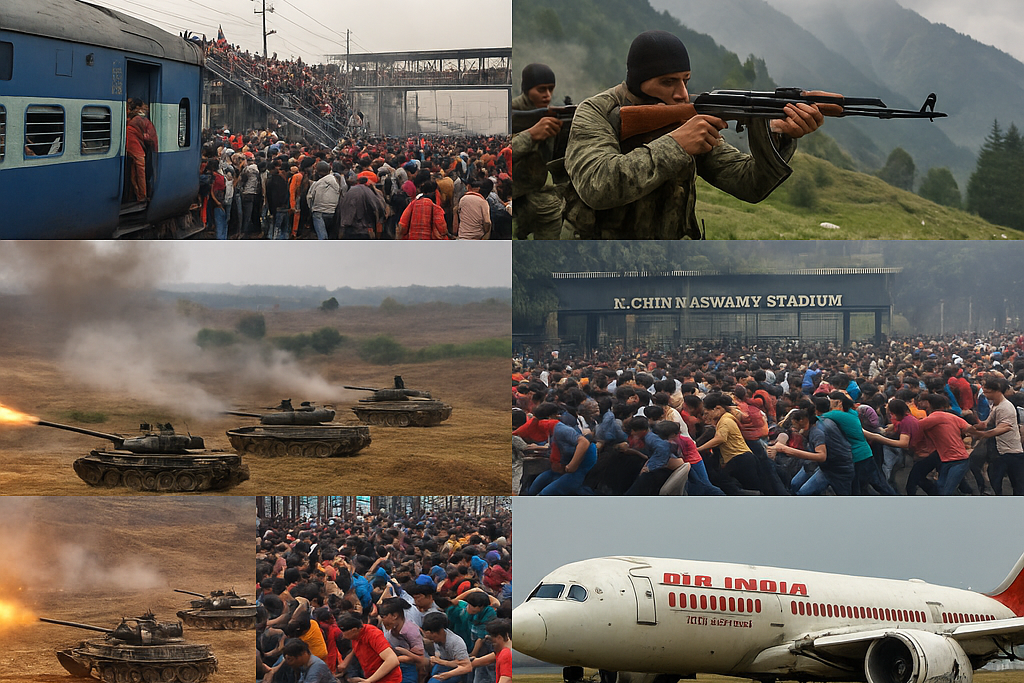
January 2025 Events
Los Angeles Wildfires (Early January)
Large-scale wildfires affected California, resulting in major structural losses and population displacement. The event reiterated persistent shortcomings in urban-wildland interface planning and mitigation.
Insight: The frequency of severe wildfires reflects gaps in fire-adaptive infrastructure in climate-stressed regions.
UK Winter Floods
Record rainfall across England, Scotland, and Wales produced flash floods, interrupting transport, agriculture, and key utilities.
Significance: Existing adaptation systems in developed countries remain insufficient for evolving precipitation extremes.
Tirupati Temple Stampede (January 8)
A crowd management failure at Tirumala Temple led to multiple fatalities. Investigations highlighted structural constraints and limited emergency-routing capacity.
Reflection: Religious and cultural sites require scalable, technology-supported crowd flow systems.
Kumbh Mela Stampede (January 29)
A crowd crush during a major procession produced significant casualties. Administrative lapses and crowd density miscalculations were central concerns.
Lesson: Predictive crowd modeling and advance risk planning are essential for high-density events.
February 2025 Events
Nepal Earthquake (February 28)
A magnitude 6.1 earthquake caused widespread structural impact across central and western Nepal. The event displaced thousands and strained response capacity.
Analysis: Himalayan urban centers require stricter implementation of seismic-resilient building standards.
Delhi Railway Station Crowd Crush (February 15)
Holiday travel congestion led to a fatal crowding incident at New Delhi Railway Station, prompting renewed scrutiny of transit-flow architecture.
Concern: Rapid urbanization and rising mobility demands are amplifying systemic pressure on transport nodes.
Knife Attack in Mulhouse, France (February 22)
A stabbing incident in a public marketplace resulted in multiple injuries. Authorities have considered ideological motives while continuing investigations.
Theme: Low-technology urban attacks continue to pose security and psychological challenges.
March 2025 Events
Cyclones Jude & Honde
Tropical cyclones significantly affected Madagascar and Mozambique, overwhelming humanitarian and emergency infrastructures.
Conclusion: African island and coastal states remain highly exposed to climate-driven displacement dynamics.
Myanmar Earthquake (March 28)
A high-magnitude earthquake caused extensive infrastructure failure and a large casualty count across central Myanmar, intensified by delayed rescue operations.
Critical Point: Seismic preparedness requires reinforcement, especially in politically constrained or resource-limited environments.
April 2025 Events
Pahalgam Incident, India (April 22)
An attack targeting tourists in Jammu & Kashmir resulted in significant civilian casualties. India’s subsequent response involved cross-border countermeasures under Operation Sindoor.
Implication: The incident underscores the volatility of the region and its influence on broader security considerations.
Fireworks Explosion in Gujarat (April 1)
An explosion linked to unauthorized industrial material storage in a residential area resulted in multiple fatalities.
Observation: Unregulated informal industrial activity carries high-risk potential in densely populated zones.
May 2025 Events
Indo-Pakistani Military Escalation (Early–Mid May)
Following the April attack, tensions escalated between India and Pakistan, including artillery exchanges, drone activity, and temporary airspace violations, until external mediation facilitated de-escalation.
Strategic Outlook: Localized terrorist incidents can act as triggers for broader military escalation in nuclear-capable regions.
St. Louis Tornado (May 16)
An EF-3 tornado caused major property damage across parts of Missouri.
Insight: Mid-latitude climatic volatility is increasing in association with broader global warming patterns.
June 2025 Events
RCB Victory Parade Incident (June 4)
Extreme crowd density at a celebratory gathering in Bangalore resulted in multiple casualties and injuries.
Takeaway: Large-scale urban events require enhanced contingency planning and mobility management.
Air India Boeing 787 Crash (June 12)
A major aviation accident near Ahmedabad resulted in the loss of all passengers on board and initiated investigations into operational, mechanical, and regulatory factors.
Broader Implication: Aviation systems face elevated pressure due to expanding fleets, maintenance demands, and global logistical strain.
London Vehicle-Ramming Incidents (June 14)
Two separate events in Tower Hamlets caused injuries to civilians. Authorities are examining ideological motivations.
Trend: European urban environments remain exposed to decentralized vehicular attacks.
Maharashtra Bridge Collapse (June 15)
A structural failure on a key tourist route caused fatalities and injuries. Preliminary findings cite material fatigue and insufficient pre-monsoon inspection.
Conclusion: Aging public infrastructure necessitates more rigorous monitoring under climate-stressed conditions.
Digital Panic and Misinformation Trends
Viral “July 5” Prophecy
A prediction circulating online, attributed to manga artist Ryo Tatsuki, gained traction worldwide. Despite no scientific basis, it produced measurable behavioral changes, including reduced tourism flows.
Interpretation: Digital misinformation can generate real economic and social effects, particularly during periods of global uncertainty.
Mid-Year Summary: Impact Overview
Sector Metrics
- Terrorism & Urban Violence: Pahalgam, France, London—30+ fatalities and more than 40 injuries.
- Environmental Disasters: Earthquakes, cyclones, wildfires—6,000+ fatalities.
- Crowd-Related Incidents: Kumbh, Tirupati, RCB, Delhi—60+ fatalities.
- Aviation Incidents: Air India and others globally—250+ fatalities.
- Military Conflicts: Escalations involving India-Pakistan, Ukraine, Gaza—casualties continue to rise.
Final Assessment
The first half of 2025 reflects intersecting vulnerabilities across climate, security, infrastructure, and information systems. These events collectively highlight the need for improved governance structures, resilient urban planning, and more coordinated global approaches to risk management.
#SystemicRisk #ClimateCrisis #RCBStampede #PahalgamAttack #GlobalStability #2025Disasters