
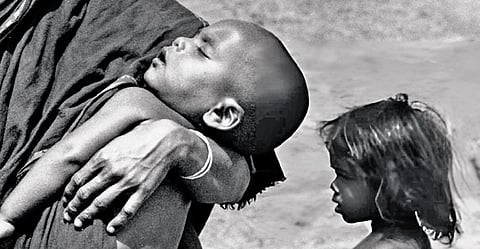
Chapter 1: Before the Blood – A Land Once Quiet
Before the world heard of Nellie, it was a peaceful stretch of land along the Brahmaputra valley. A mosaic of hamlets—Tewa, Borjuri, Mati Parbat, Muladhari, Alisinga—rested under the gentle Assam sun. Mornings here began with the smell of burning wood, roosters crowing, and women drawing water from the Kopili river. Children ran barefoot through the soft mud, and elders rested under bamboo groves.
Life was ordinary. Life was familiar. Life was shared.
In these villages lived a blend of communities—Tiwas, Assamese Hindus, Bengali-origin Muslims, Karbis, Bodos, Nepalis. They exchanged crops, traded stories, and lived side-by-side for decades. Festivals were celebrated together. Floods were endured together. Grief and joy were shared as one.
But beneath this surface of harmony, something darker was slowly taking shape.
A storm was gathering—not in Nellie, but in Assam’s politics.
Chapter 2: The Spark That Became a Wildfire
Between 1979 and 1983, Assam was in turmoil. A mass movement known as the Assam Agitation spread like wildfire. The fear of illegal immigration had gripped the state, and slogans of “Detect, Delete, Deport” filled the air.
Election rolls were questioned. Citizenship became a weapon. Suspicion grew as fast as paddy in monsoon.
Rumours reached even the quietest corners of villages:
- “Your names will be removed.”
- “New settlers will take your land.”
- “Do not vote; boycott the elections.”
When the government announced the 1983 Assam Elections despite widespread opposition, tension reached its breaking point.
In Nellie and nearby villages, many Bengali-origin Muslim families decided to vote. For them, voting was not rebellion—it was survival. It was a declaration that they too belonged to this land.
But to others, it was seen as defiance.
A betrayal.
A provocation.
The ground beneath Nellie was becoming dry gunpowder.
Chapter 3: The Morning the Sun Turned Red
18 February 1983.
The day began like any other.
Mist rose from the fields. Children laughed. Mothers prepared rice. Cattle grazed lazily.
But then—
A sound.
A rumble.
A vibration in the ground.
At first, the villagers thought it was thunder. But it grew louder—like hundreds of feet. Like drums. Like a storm approaching.
Within minutes, from every direction, attackers appeared.
Hundreds.
Then thousands.
Armed with daos, spears, lathis, bows, arrows, kerosene-soaked torches.
They surrounded Nellie’s hamlets in a formation that seemed frighteningly organized.
There was no escape.
The Attack
Huts were set on fire.
Families were dragged out.
People running for their lives were cut down.
Mothers shielded their children with their bodies.
The river Kopili witnessed horrors it has never forgotten.
For six hours—six long, unending, merciless hours—violence swallowed Nellie.
By the time the sun began to set, 1,800 people were officially declared dead.
Survivors say it was far more—perhaps 3,000 to 5,000.
Most of the victims were women and children.
Whole families disappeared.
Whole villages burned.
The land that once smelled of earth and paddy now smelled of smoke, blood, and grief.
Chapter 4: The Day After – A Village of Ghosts
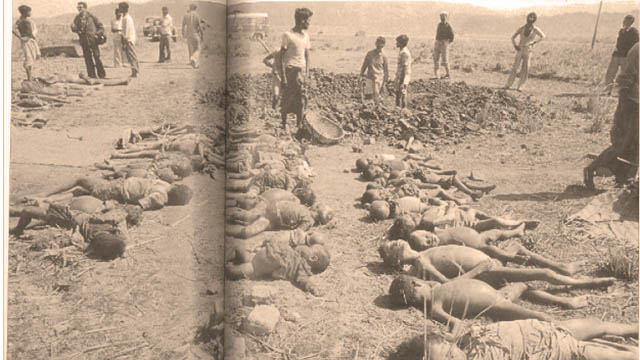
When the attackers left, silence took their place—a silence so heavy it felt suffocating.
Survivors walked through the ashes of their homes like shadows.
Some searched for loved ones.
Some found bodies.
Some never did.
The relief teams arrived the next day, but nothing they brought—tents, rice, medicines—could mend the broken hearts of Nellie.
The government formed the Tiwari Commission to investigate the massacre.
But the report was never released.
Cases were filed.
Witnesses testified.
But one by one, 688 cases were dropped.
Not a single person was punished.
Not one.
Justice died before the dead were even buried.
Chapter 5: The Children Who Lost Their World
The massacre did not just take lives. It took childhoods.
Hundreds of children were orphaned.
Many were found sitting beside the bodies of their families—too shocked to cry.
Relief camps became home.
Food was never enough.
Nightmares were constant.
As they grew older, these children carried scars that no eye could see:
- Fear of loud noises
- Fear of crowds
- Fear of elections
- Fear of being the “other”
Some left Nellie forever, carrying their trauma into adulthood.
Some stayed because leaving meant abandoning the last memory of those they lost.
Their lives became quiet monuments to a tragedy the nation forgot.
Chapter 6: Why Did Nellie Happen? – A Brutally Honest Look
Nellie was not a spontaneous event.
It was the conclusion of:
1. Political Chaos
Assam was divided between agitation and governance.
Identity was a battleground.
2. Rumours and Fear
False information spread faster than truth.
Fear transformed into anger.
Anger into violence.
3. Election Pressure
One group voting while another boycotted created an explosive situation.
4. Administrative Failure
Warnings were ignored.
Protection was insufficient.
Help arrived too late.
5. Human Vulnerability to Manipulation
Ordinary people were influenced by fear, leaders, and misinformation.
Neighbors who once shared meals now saw each other as threats.
The fault did not lie with any one community.
It lay with politics, fear, and the failure of humanity.
Chapter 7: Rising from Ashes – Nellie Today
Forty years later, Nellie is no longer a land of ruins.
The paddy fields are green again.
Children run along the same paths where blood once flowed.
Life has returned.
Quietly.
But every family still carries a story.
A loss.
A memory.
During elections, the fear returns.
When the topic of “identity” surfaces, old wounds ache.
Yet, the resilience of Nellie’s people is remarkable.
They rebuilt not through anger, but through courage.
Final Chapter: Why the Story of Nellie Must Be Told
The most painful part of the Nellie Massacre is not just the brutality.
It is the silence that followed.
The textbooks didn’t mention it.
The leaders didn’t talk about it.
The nation moved on.
But Nellie did not.
Nellie cannot.
This story must be told because:
- Forgetting is dangerous.
- Silence is injustice.
- Truth is the first step toward healing.
Nellie is not a story of communities against each other.
It is a story of what happens when fear replaces trust.
When politics replaces humanity.
When rumours replace truth.
The people of Nellie still wait—not for revenge, but for remembrance.
Because some tragedies must be remembered to make sure they never return.
This is the untold horror of Nellie. A story India should never have buried.